
Penning Nirvana
"I prefer the pen. There is something elemental about the glide and flow of nib and ink on paper." -- James Robertson

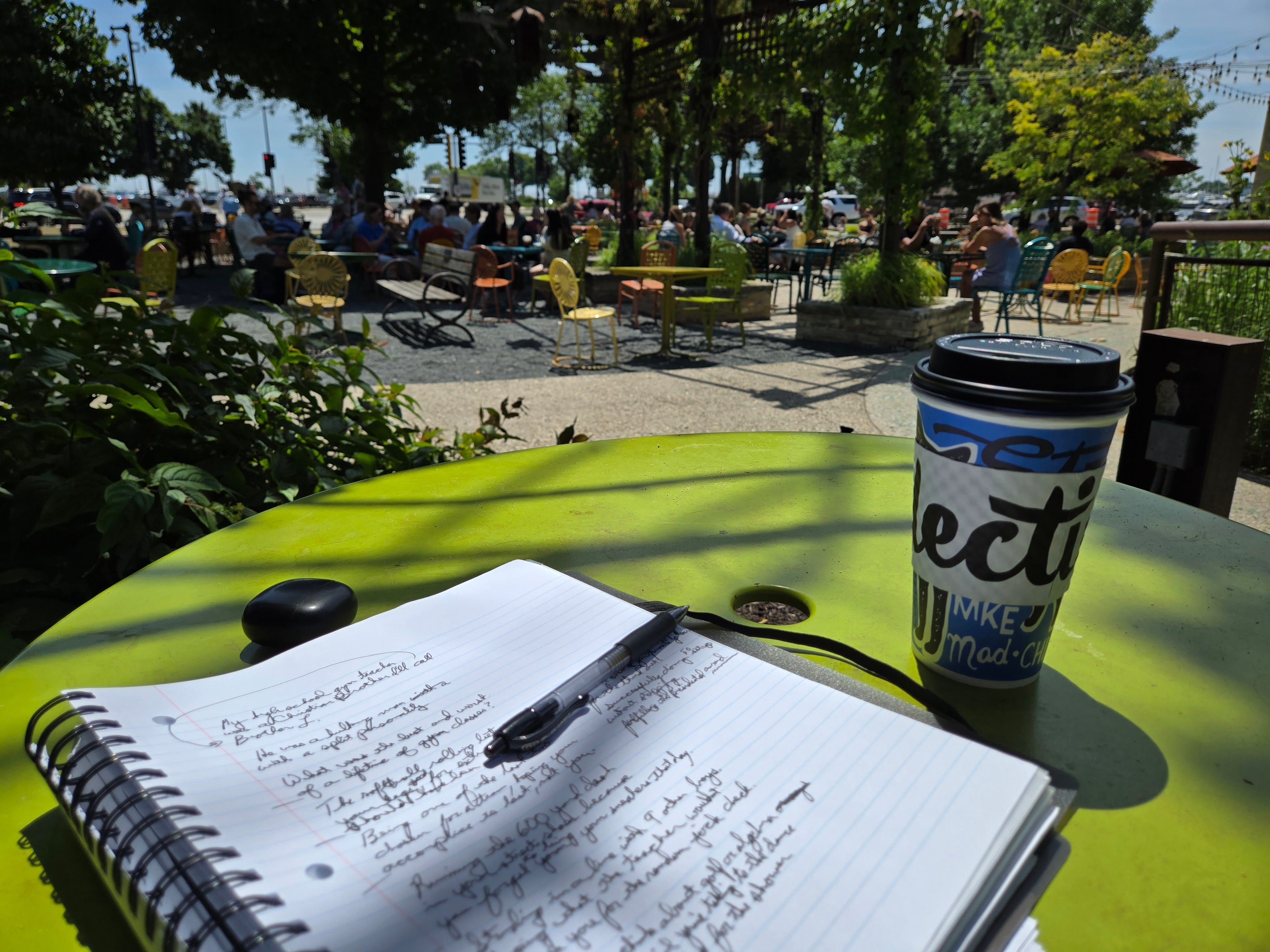
I sit here writing this post in longhand. This is a first for me and is a bit of an experiment. (It’s also beastly hot in my office, so I retreated to my centrally cooled living room.) A few days ago during a walk through the neighborhood, I decided to post a little about my writing journey: What brought me here; what inspiration or broken part of me compels me to pen my stories; and where am I going with it all? Sometimes, in the midst of multiple ongoing projects, it helps to take a step back and go, hmmm.
Writing for health
Anyway, I’m writing in longhand after reading an article—one I’ll probably never be able to find again—that talked about how the human brain is stimulated when you use pen and paper versus typing away on a laptop. A much larger portion of your gray matter “lights up” for lack of a better term when you are writing in cursive or printing your thoughts. It probably has something to do with dragging a pen while recalling—hundreds of times a minute—the shape of each letter, the spelling of each word, and the structure of each sentence. Don’t forget that when you write longhand, you’re also dotting i’s and crossing t’s, scratching commas and finishing with periods. Maybe there’s even a few doodles as you think about what your next sentence will be.
If I think about the practice of writing each word and how my penmanship differs from my wife’s, my kids, or anyone else, I realize it is an art in itself. I’ve never been a sketch artist, but have no problem filling page after page with swooping words made of scrolls, curlicues, dashes, commas, all ending with little dots. Some would say, “That’s not art.” I beg to differ. It is black and white art to the artist, done in a way that can be interpreted by the art appreciation recipient (reader, in this case).
I could go on to talk about how cursive writing is a dying art, in part because many schools have removed it from their curriculums, but plenty of other people have written about that, probably on their laptop, which is the definition of irony if you think about it. Here’ are a few links to more on that subject.
Here’s a clinical mouthful talking about what handwriting is.
“…handwriting involves the coordination of linguistic, motor, and visuospatial processes, a set of operations that allow abstract orthographic representations to be mapped into graphomotor patterns distributed over a two-dimensional space.”–Source: National Library of Medicine
Dude, where’s my limo?
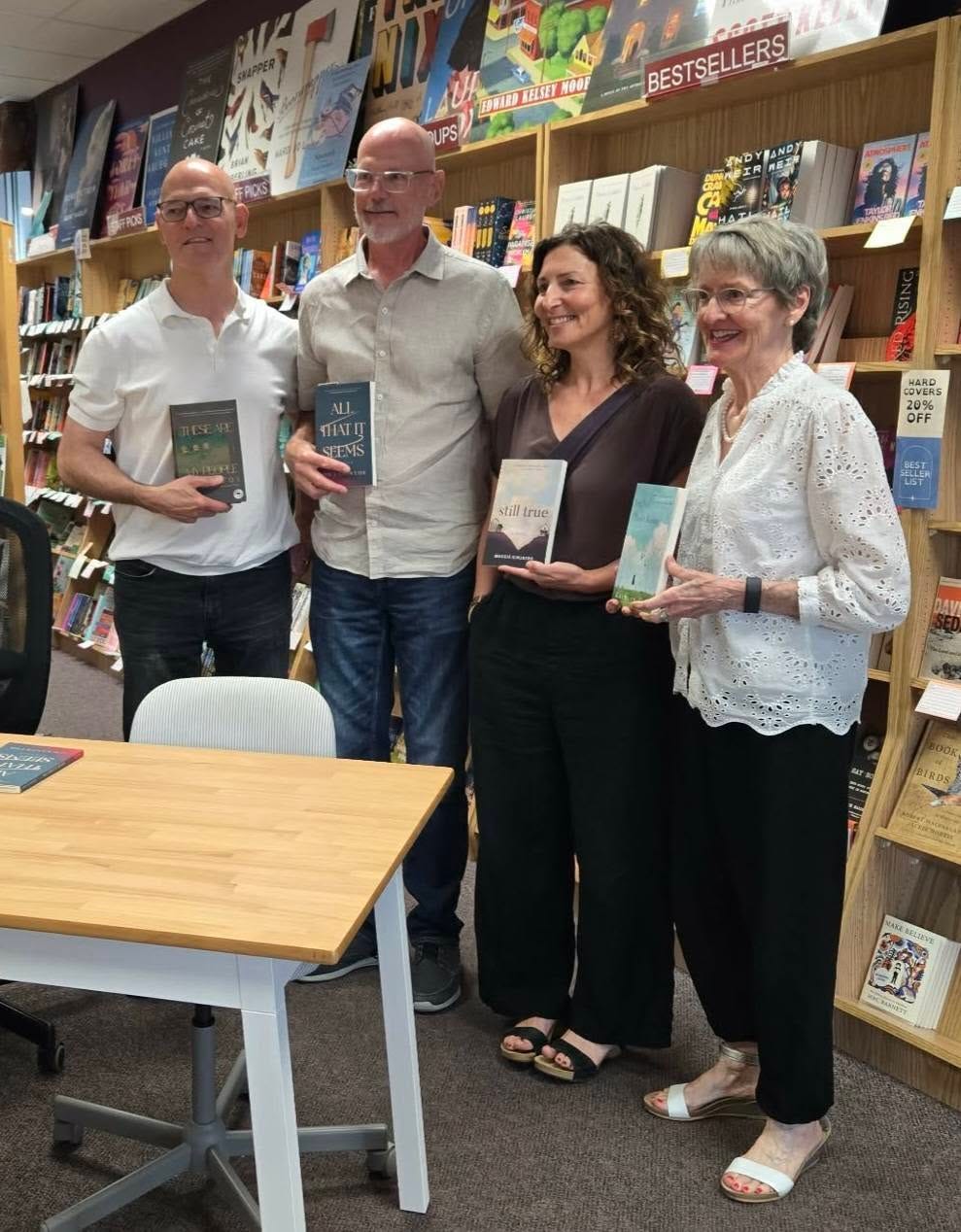
The inspiration behind my decision to write about my writing was a book event I was part of this past weekend. Two other authors and I were part of a panel that talked about short story writing. Like myself, my colleagues, Kathryn Gahl (Yes, No, I Don’t Know) and Steve Fox (These Are My People) both recently released short story collections with Cornerstone Press, the publisher of my book, All That It Seems (and, At the Lake, 2024). We were fortunate to have author Maggie Ginsberg (Still True) serve as moderator and conversationalist. I’ve done these types of panels before, and I always come away inspired and energized.
One of the interesting takeaways for me was when Steve mentioned he had always enjoyed writing ever since he was a young kid. Reading Dr. Seuss’s books taught him that playing with words could be fun. And we all know there is nothing more fun than the playfulness of Dr. Seuss’ books.
Green eggs and ham can change your life
His observation about Seuss made me pause and think about whether I always knew I wanted to be a writer someday. Or maybe it was just that my love of it just grew along with me as I did other things. I started it over 15 years ago while I worked my tech job, and it has become a centerpiece in my days lately. I can’t imagine life without it. But it wasn’t always this way. While I don’t profess to be musically inclined, writing is like any instrument. The more you practice, the better you play, which makes you not mind practicing so much, which in-turn makes you better; repeat.
Writing was never a chore for me, never arduous. The more I did it, the more I needed to do it. So Steve’s observation about Seuss made me wonder whether it was something innate in me or simply became a learned behavior. It made me think deep, philosophical questions like:
What drove me to write 4-page short stories in the fourth grade on half sheets of loose leaf? If nothing else, my homeroom teacher, Sister Patricia, sure liked them. I’ll always remember her for this praise and encouragement.
Why did I want to send letters to friends and family just for something to do? Everyone said, “You write such great letters.”
Did I make the writing, or did it make me? Or, maybe it forces change, and we bend to that change. I guess I’ll never have the real answer.
Writing as a fine and pleasant misery
Unlike Steve, though, my inspiration for writing came later with authors like Patrick F. McManus, Erma Bombeck, and Kurt Vonnegut. Dr. Seuss could probably be included in there too, in his own way.
I guess if I have one regret, it’s not recognizing my passion for writing while I was in college. If I had, I likely would have pursued English, journalism, or something that involved more of it. Instead, my college years were spent grinding out term papers on subjects like Darwin’s evolutionary theory or the takeaways from my archaeology field school as summarized in my senior thesis. Riveting stuff!
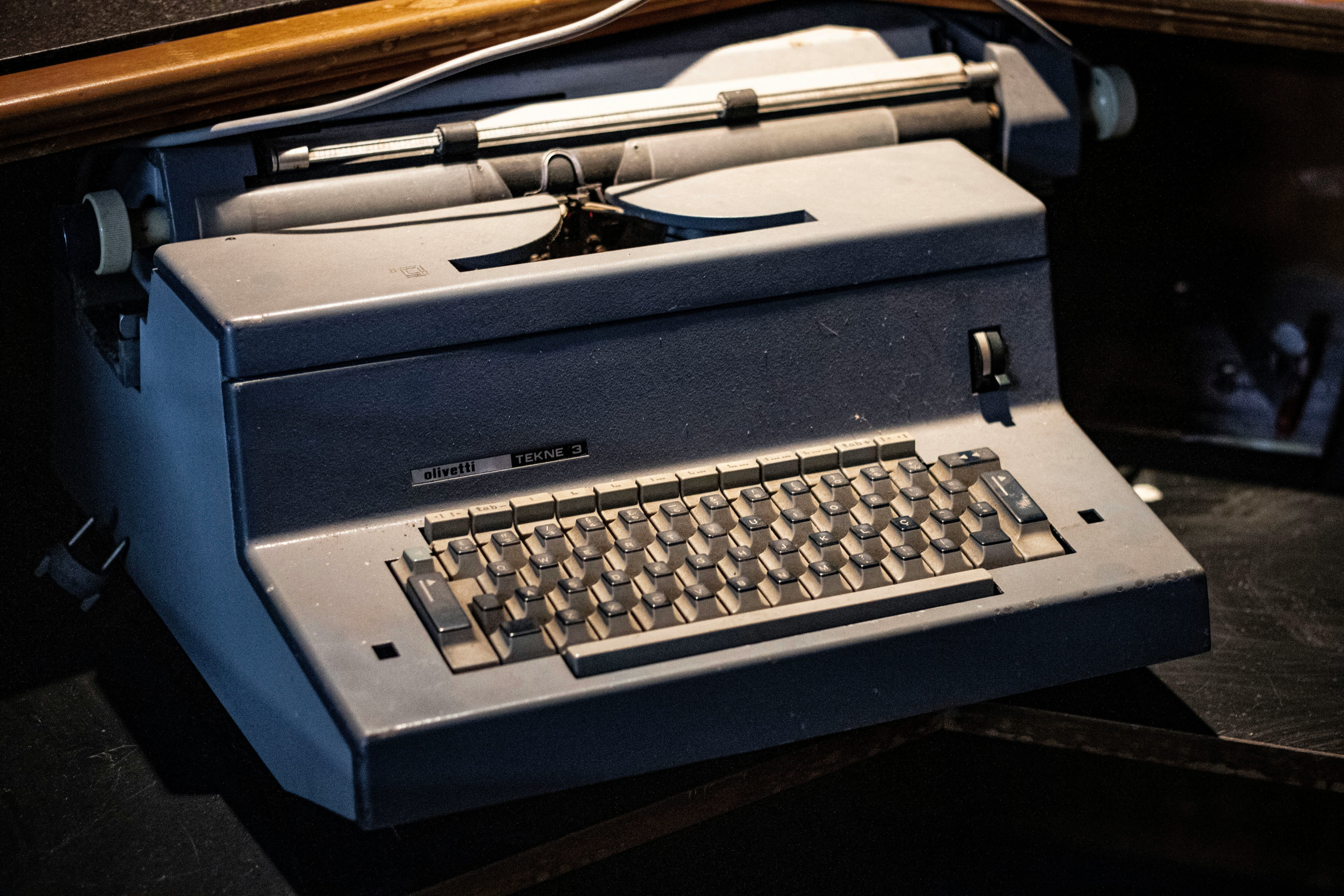
As it goes, it wasn’t until after I graduated that I started to appreciate that I might have a gift or talent for writing. I did a fair amount of handwriting letters to friends and family back when personalized letters were a thing and email was just a crackpot idea in some techie’s head. But it was comments of encouragement that fueled my desire to take my writing more seriously. More than one person said, “I just love your letters. You’re such a talented writer.” Well, shucks. Thank you. Words like that stay with a person. Never doubt the power of your words to bolster someone trying to make their way at something new to them.
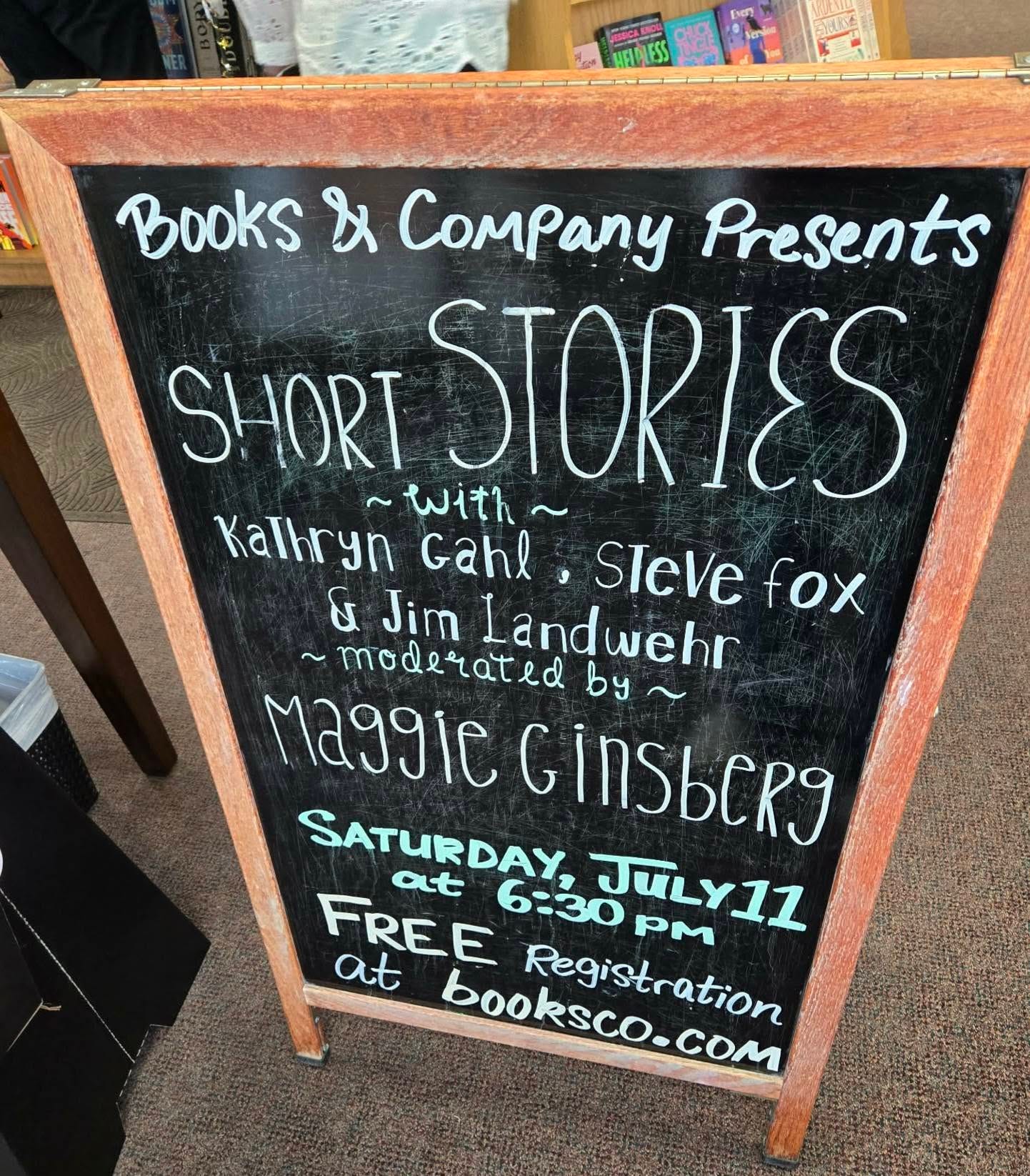
So, as I sat there among three colleagues, all of whom I look to be as good as someday, I was reminded how privileged I was to be “on stage” with them. In a loose sense of the words, I felt like “I’d arrived.” No, it was not New York. No, it wasn’t a “big five” book from Random House. No, I will never be rich because of my writing.
A community of word geeks
Nevertheless, there I was, elbow-to-elbow with a few Wisconsin authors as passionate about the craft as I am, all sharing a “5 minutes of fame” moment. Afterward, we signed books and then broke off into our own little conversations. It was in these moments that we encouraged one another to keep grinding away. Along with the supportive words, we shared our laments, gripes, and successes too. As much as I enjoyed talking about the craft during the main event, it was equally gratifying talking to my readers and colleagues about the next exciting project I’m working on or looking forward to.
The whole evening reminded me that despite how far I’ve come, there’s still a lot to learn. And it was good to know that I’m not alone.
Side out: Incidentally, the Substack platform has shown me that there are more people like me than I ever would have thought who just “started writing.” It is a community of all ages, genders, abilities, and voices. Just as it should be.
Writing is a landscape, not a lane.
Proud of you for always pursuing your passions. 💜
Got to love this! Love the spirit in you Jim! And I love the commitment. Not easy I know but as you do as well - I'm not exactly fond of the alternative.